FundTap Platform Rebuild:
From a Laravel Monolith to Java Microservices

Industry Fintech — Invoice Finance
Engagement Platform Re-engineering & Dedicated Engineering Team
Delivered by Mejora Infotech, an established fintech application development company trusted by lenders to modernise mission-critical platforms.

Let’s Discuss Your Financial Software Project

Whether you require a custom banking application, payment gateway integration, lending platform, insurance software, or wealth management solution, we're here to help you. Fill out the form and our specialists will contact you shortly.

    The Client

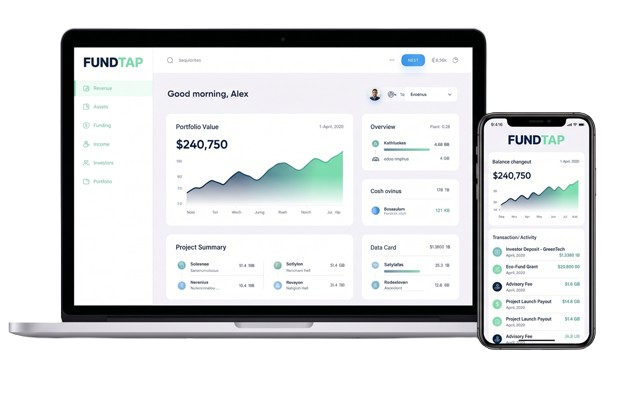
    FundTap operates a web-based invoice funding platform that lets small and medium businesses release the cash tied up in unpaid invoices. Borrowers register on the platform, submit a funding application against an invoice — either by uploading it directly or by synchronising it from their accounting software — and receive approved funds in their nominated bank or payment account. The platform serves three user groups: borrowers, agents who introduce business and earn a predetermined commission, and system administrators who manage lending decisions, servicing and compliance.

    The original platform was built to prove and validate the FundTap business model, and it did so successfully. Growth in customers and transaction volume then exposed the limits of the technology it had been built on.

    poket image

    Business Need

    FundTap approached Mejora Infotech for financial services application development consulting to rebuild the platform for its next phase of growth. The existing Laravel (PHP) application had served the validation stage well, but several constraints had become material to the business.

    01

    A validated product outgrowing its original architecture

    The platform had been engineered for speed of launch, not for scale. Onboarding a substantially larger customer base and processing high transaction volumes required horizontal scalability the existing system could not provide.

    02

    Performance under transaction load

    Peak usage produced performance bottlenecks. The application had limited support for high-concurrency and multi-threaded processing, which mattered increasingly as funding, repayment and reconciliation activity grew.

    03

    Latency in third-party accounting integrations

    The platform depends on live connections to Xero, MYOB, QuickBooks and Reckon for invoice synchronisation, profit and loss data, balance sheets, bank transactions and invoice writeback. These integrations, along with report generation, carried high latency that affected the day-to-day experience of both borrowers and administrators.

    04

    A monolith that resisted safe change

    Every change required the whole application to be rebuilt, retested and redeployed, and a defect in one area could surface in unrelated parts of the system. As the codebase expanded, maintenance overhead and regression risk grew with it.

    05

    Growing complexity in financial logic

    Funding, repayment, commission and writeback rules had become increasingly intricate. Holding that logic in a single codebase made it harder to reason about, test and extend.

    06

    Data not structured for reporting or AI

    FundTap wanted to use its own data for richer reporting, machine learning and future AI tooling. The existing data organisation was not designed for that, limiting what the business could extract from information it already held.

    07

    Security and compliance expectations of a lender

    As a financial services platform handling customer and transaction data, FundTap needed the rebuild to meet current cybersecurity practice and to stand up to an evolving risk and compliance landscape.

    08

    Continuity as a hard constraint

    The rebuild could not become a product change programme. Aside from two additions — allowing an account holder to invite users to their customer account, and carrying across any functionality added to the live platform during the project — the user interface, user experience and functionality had to remain the same while the database and architecture underneath were completely redesigned.

    Tailored Solutions

    Drawing on its fintech application development services, Mejora Infotech rebuilt the platform on a modern Java stack and replaced the monolith with a microservices architecture, keeping the product experience stable throughout.

    Migration from PHP to Java

    The platform was rebuilt using Java with Spring Boot. Java was selected for its performance under high transaction volumes, its support for multi-threading, concurrency and asynchronous processing, its suitability for complex financial workflows, and its strong typing and structured error handling, which reduce runtime risk. The maturity of the ecosystem and the availability of experienced financial application developer talent also made the platform easier to staff and maintain over the long term.

    dashoard image

    Decomposition into 11 microservices

    Moving to Java addressed the limitations of the underlying technology, but the monolithic structure itself remained a constraint. The platform was therefore decomposed into 11 independently deployable microservices, each owning a distinct business capability. Service boundaries were drawn around business capabilities rather than technical layers, which kept the number of moving parts manageable for the team while still delivering independent deployment. This gave FundTap independent scaling of transaction-heavy services such as funding and payment processing, fault isolation so a failure in one service does not bring down the platform, faster and lower-risk releases, and the ability to upgrade or replace individual services without another full-platform rewrite.

    A database per service

    Each service manages its own PostgreSQL database on Amazon RDS rather than sharing a single schema. This removed the data coupling that had made changes risky in the monolith and allowed each service to evolve its own data model.

    Communication and event streaming

    REST APIs are used for client, third-party and external integration traffic. gRPC, based on Protocol Buffers, handles internal service-to-service communication for its performance and streaming support. Apache Kafka provides the asynchronous messaging backbone, letting services publish and consume events without direct dependencies on one another and supporting event-driven workflows and real-time data pipelines.

    Rebuilt integration layer

    The connections to Xero, MYOB, QuickBooks and Reckon were rebuilt as part of the new architecture, covering invoice synchronisation, organisation and contact data, profit and loss and balance sheet reporting, bank transactions, payments and invoice writeback. Beyond accounting, the rebuild carried the platform's wider integration set: APLYiD for identity verification and KYC checks at onboarding, Annature for digital signing of loan documents, and HubSpot for sales pipeline and customer records. Together these support a single continuous flow from first enquiry through identity verification, signed agreement and funded invoice.

    Cloud-native deployment on AWS

    Services are containerised with Docker and orchestrated on Kubernetes, with images stored in Amazon ECR. AWS API Gateway provides a single, secured entry point for API traffic. The supporting infrastructure uses Amazon EC2, Amazon RDS, Amazon S3, Route 53, Elastic Load Balancing, Auto Scaling, AWS Secrets Manager, AWS Certificate Manager and Amazon CloudWatch. Redis provides server-level caching, and AWS QuickSight supports business intelligence and data visualisation.

    Automated build and release pipeline

    Source control runs on Bitbucket with separate development, staging and master repositories. Webhooks trigger automated builds on commit through Jenkins and AWS CodeBuild, running static analysis and unit tests with defined thresholds for code coverage and pass rate. Container images are tagged by commit ID, pushed to ECR, and rolled out to Kubernetes as rolling updates, giving deployments without downtime and a clear path back to any previous build.

    Security built into the design

    Security was treated as a design requirement rather than a hardening step. Credentials are hashed using algorithms intended for password storage, secrets are held in AWS Secrets Manager rather than in configuration, database access uses parameterised queries and query bindings, file upload handling is constrained, and TLS certificates are managed centrally. Rotation of keys and secrets was planned into operations from the start.

    Environment separation

    The platform runs across separate development, QA, staging and production environments, each with its own isolated data stores, so changes can be validated at every stage before reaching customers.

    Services Involved

    Legacy application modernisation and re-engineering

    Software architecture and system design

    Backend engineering — Java, Spring Boot, microservices

    Frontend engineering — React

    Cloud engineering and DevOps — AWS, Docker, Kubernetes, CI/CD

    Third-party API integration engineering

    Quality assurance and testing

    Dedicated offshore engineering team

    Technology Stack

    Area
    Technology
    API protocol
    REST
    API services
    Java, Spring Boot
    Internal service communication
    gRPC
    API gateway
    AWS API Gateway
    Relational database
    PostgreSQL on Amazon RDS
    Event streaming
    Apache Kafka
    Caching
    Redis
    Frontend
    React
    Containerisation and orchestration
    Docker, Kubernetes (Amazon EKS), Amazon ECR
    CI/CD
    Jenkins, AWS CodeBuild
    Version control
    Bitbucket
    Cloud infrastructure
    Amazon EC2, S3, Route 53, ELB/ALB, Auto Scaling, AWS Secrets Manager, AWS Certificate Manager, Amazon CloudWatch.
    Business intelligence
    AWS QuickSight
    Third-party integrations
    Xero, MYOB, QuickBooks, Reckon, APLYiD, Annature, HubSpot.

    Results

    A platform built to scale horizontally

    Transaction-heavy services can now be scaled independently as volume grows, without provisioning capacity across the entire platform.

    Failures contained to a single service

    Fault isolation means a problem in one capability no longer degrades the whole system — a material change for a platform processing live financial transactions.

    Shorter, safer release cycles

    A single service can be built, tested and deployed on its own through the automated pipeline, replacing full-platform releases and reducing the regression risk that came with them.

    Financial logic under control

    Funding, repayment, risk and reporting logic now sit behind clear service boundaries, making complex rules easier to change and test with confidence.

    Data organised for reporting and AI

    With well-defined service ownership and a structured data model, FundTap's data is positioned for enhanced reporting, machine learning and future AI tooling rather than being locked inside application logic.

    Continuity for existing customers

    The rebuild delivered a completely new backend architecture while keeping the interface and workflows customers already knew, avoiding retraining and disruption.

    Benefits to the Business

    Room to grow. The platform can take on a substantially larger customer base without a further re-architecture.

    Lower operational risk. Isolated services, automated testing and rolling deployments reduce the chance and the blast radius of production incidents.

    Faster delivery of new features. Independent services let engineers work in parallel with fewer merge conflicts and less release coordination.

    Stronger security and compliance posture. Isolating authentication, payments and risk assessment simplifies access control, auditing and the evidence needed for compliance.

    Easier team scaling. A mainstream Java stack with documented services makes it straightforward to bring new engineers on and get them productive.

    Long-term cost efficiency. Predictable system behaviour reduces ongoing performance tuning and firefighting effort.

    Ready for what's next. The API-first, service-based architecture gives FundTap a clean foundation for mobile financial applications development, so a native app can plug into the same secure backend without another rebuild.

    Conclusion

    Laravel served FundTap well while the business model was being proved, enabling a fast launch and rapid iteration. As customer numbers and transaction volumes grew, the same architecture became the constraint. Rebuilding the platform in Java and restructuring it into 11 independently deployable microservices gave FundTap an enterprise-ready system that scales horizontally, contains failure, supports complex financial operations and regulatory requirements, and can evolve service by service — all while the experience its customers rely on stayed the same.

    Have a similar challenge?

    Let's build a scalable solution for your business.

    Partner with us to engineer high-impact systems tailored to your goals. Take the first step toward long-term efficiency and growth today.

    Request a Free Consultation